Latona
in the gardens of the Palace of Versailles
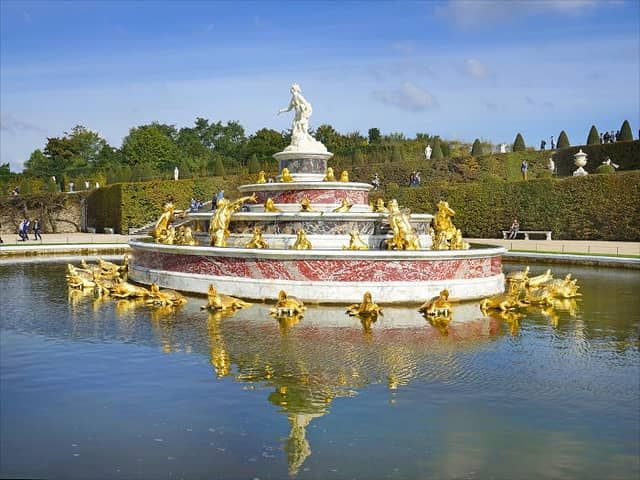
“The curse as soon as uttered took effect, and every one of them began to swim beneath the water, and to leap and plunge deep in the pool”, “The Metamorphoses”, Book VI, verses 370 to 374.
The Latona Fountain and ParterreLatona Fountain and Parterre(Bassin et le Parterre de Latone)Latona Fountain and Parterre appear from the palace’s western facade, after the Ornamental PoolOrnamental Pool( Parterre d'Eau)Ornamental Pool, as Louis XIV (opens in a new tab) wrote in the second paragraph of his “Way to present the Gardens of VersaillesWay to present the Gardens of Versailles(Manière de montrer les jardins de Versailles)Way to present the Gardens of Versailles” (opens in a new tab):
“One has to go straight to the top of Latona and make a break to consider Latona and the Lezards, the ramps, the statues,
the Royal Alleythe Royal Alley(l’Allée Royale)the Royal Alley
,
the Apollothe Apollo(l’Apollon)the Apollo
, the canal then turn around back to see the Parterre and the château.”
Here is a fountain inspired by the opposition between Latona (opens in a new tab), that was to give birth, despite the persecution of goddess Juno (opens in a new tab), to twins, Apollo (opens in a new tab), god of the sun, Diana (opens in a new tab), goddess of the moon and the Lycian (opens in a new tab) peasants.
With the text written by Ovid (opens in a new tab) in Book VI of “The Metamorphoses (opens in a new tab)”, this opposition should probably come closer to us.
Latona according to the text of Book VI of “The Metamorphoses”
333 There Latona, as she leaned against a palm-tree—and against the tree
most sacred to Minerva, brought forth twins, although their harsh step-mother, Juno, strove
to interfere.— And from the island forced
to fly by jealous Juno, on her breast she bore her children, twin Divinities.
340 At last, outwearied with the toil, and parched with thirst—long-wandering in those heated days
over the arid land of Lycia, where was bred the dire Chimaera— at the time
her parching breasts were drained, she saw this pool
of crystal water, shimmering in the vale.
Some countrymen were there to gather reeds, and useful osiers, and the bulrush, found
with sedge in fenny pools. To them approached
345 Latona, and she knelt upon the verge
to cool her thirst, with some refreshing water.
But those clowns forbade her and the goddess cried, as they so wickedly opposed her need:
“Why do you so resist my bitter thirst?The use of water is the sacred right350
of all mankind, for Nature has not madethe sun and air and water, for the sole
estate of any creature;and to Herkind bounty I appeal, although of you
I humbly beg the use of it.Not here
do I intend to bathe my wearied limbs.
I only wish to quench an urgent thirst,for, even as I speak, my cracking lips355
and mouth so parched, almost deny me words.
A drink of water will be like a draughtof nectar, giving life; and I shall owe
to you the bounty and my life renewed.—
ah, let these tender infants, whose weak armsimplore you from my bosom, but inclineyour hearts to pity!”it chanced the children did stretch out their arms
360 and who would not be touched to hear such words, as spoken by this goddess, and refuse?
But still those clowns persisted in their wrong against the goddess; for they hindered her,
and threatened with their foul, abusive tongues
to frighten her away—and, worse than all,
365 they even muddied with their hands and feet the clear pool; forcing the vile, slimy dregs
up from the bottom, in a spiteful way, by jumping up and down.— Enraged at this,
she felt no further thirst, nor would she deign
to supplicate again; but, feeling all
the outraged majesty of her high state,
she raised her hands to Heaven, and exclaimed,
“Forever may you live in that mud-pool!”370 The curse as soon as uttered took effect, and every one of them began to swim
beneath the water, and to leap and plunge deep in the pool. —Now, up they raise their heads,
now swim upon the surface, now they squat themselves around the marshy margent, now
they plump again down to the chilly deeps.
And, ever and again, with croaking throats, indulge offensive strife upon the banks,
375 or even under water, boom abuse.
Their ugly voices cause their bloated necks to puff out; and their widened jaws are made still wider in the venting of their spleen.
Their backs, so closely fastened to their heads, make them appear as if their shrunken necks
have been cut off. Their backbones are dark green; white are their bellies, now their largest part.—
379 Forever since that time, the foolish frogs muddy their own pools, where they leap and dive.